
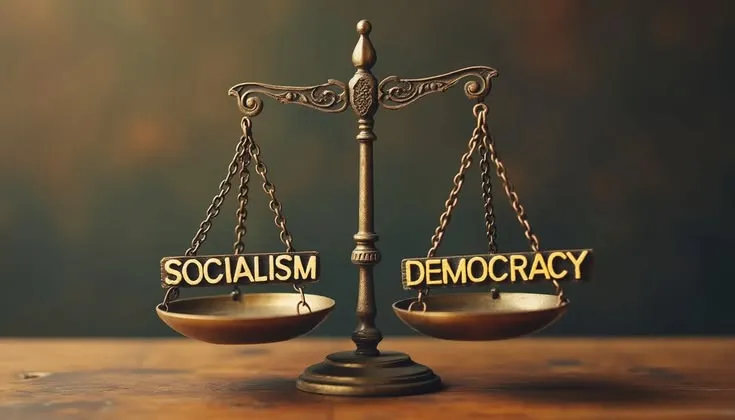
Political labels are useful shortcuts, but they can also create confusion. Terms such as liberalism, conservatism, socialism, and libertarianism often carry different meanings depending on the country, period, or speaker. Two traditions may support similar policies for different reasons, while movements with shared roots may disagree over markets, ownership, or the role of the state. For students and general readers, comparison is often more useful than memorizing isolated definitions because it shows both overlap and underlying differences.
Why Similar Labels Can Hide Important Differences
A good example is the debate around social democracy vs democratic socialism. The two traditions belong to the broader left and commonly support democratic participation, labor protections, public services, and efforts to reduce inequality.
The main distinction usually concerns the long-term role of private ownership and markets. Modern social democracy generally accepts a mixed economy in which private enterprise operates alongside regulation, taxation, welfare programs, and public services. Democratic socialism places greater emphasis on extending democratic or social control over economic life and may seek deeper changes in ownership and decision-making.
These are broad traditions rather than fixed policy manuals, so parties and thinkers within each can disagree.
Look Beyond One Policy Position
Comparing ideologies only by asking whether they support a particular program can be misleading. Two traditions may favor the same policy while reaching that position through different principles.
Support for a public service, for example, might be justified through equality, social solidarity, economic efficiency, individual opportunity, or national cohesion. The policy may look similar on the surface even when the reasoning behind it differs.
A stronger comparison asks several questions:
-
What does the ideology believe about individual rights and collective obligations?
-
How much economic inequality is considered acceptable?
-
What role should markets play?
-
When is government intervention justified?
-
How should political and economic power be distributed?
Why Side-by-Side Comparison Helps
Resources that let readers compare political ideologies side by side make these differences easier to see. Instead of moving between separate definitions, readers can examine how two traditions approach authority, liberty, equality, property, institutions, and social change at the same time.
This is especially useful when ideologies belong to the same political family. Similar traditions often disagree over degree rather than direction. Direct comparison helps prevent the common mistake of treating every movement on the same side of the political spectrum as identical.
It can also clarify disagreements over shared words. “Freedom,” for instance, may refer mainly to freedom from government interference, freedom from economic dependence, political participation, or a combination of these ideas.
History Changes Political Meaning
Political ideologies develop over time. A label used in the nineteenth century may not carry the same meaning today, and the same term can develop differently in the United States, Europe, Latin America, or elsewhere.
Industrialization, war, economic crises, suffrage expansion, civil-rights movements, decolonization, and changes in labor organization have all influenced political thought. Readers should therefore ask how a tradition developed, which problems it was responding to, and how later movements adapted its ideas.
Avoid Turning Comparison Into a Ranking
A comparison should explain differences before judging them. Political education becomes weaker when an ideology is reduced to a slogan or described only through the criticisms made by opponents.
A more useful approach is to identify each tradition’s stated goals, institutional preferences, internal debates, and common criticisms. This does not mean pretending all arguments are equally persuasive. It simply separates description from evaluation.
Once readers understand what each tradition actually claims, they are in a better position to decide which arguments they find convincing.
Political Ideas Connect to Institutions
Ideologies matter because they shape how people think governments, markets, communities, and individuals should relate to one another. Those beliefs influence debates over taxation, welfare, labor law, education, regulation, civil liberties, public ownership, and constitutional structure.
Instead of asking whether a politician or party fits perfectly into one category, readers can examine which ideas appear in particular policies and where those ideas come from.
Conclusion
Political ideologies are easier to understand when they are compared as systems of ideas rather than treated as competing labels. Social democracy and democratic socialism show how traditions can share democratic and egalitarian goals while differing over markets, ownership, and the depth of economic reform.
Side-by-side comparison also helps readers recognize that political language changes across time and place. The goal is not to force every person or party into a rigid box. It is to understand the assumptions behind political arguments so disagreements about government, rights, equality, and economic organization become clearer.